
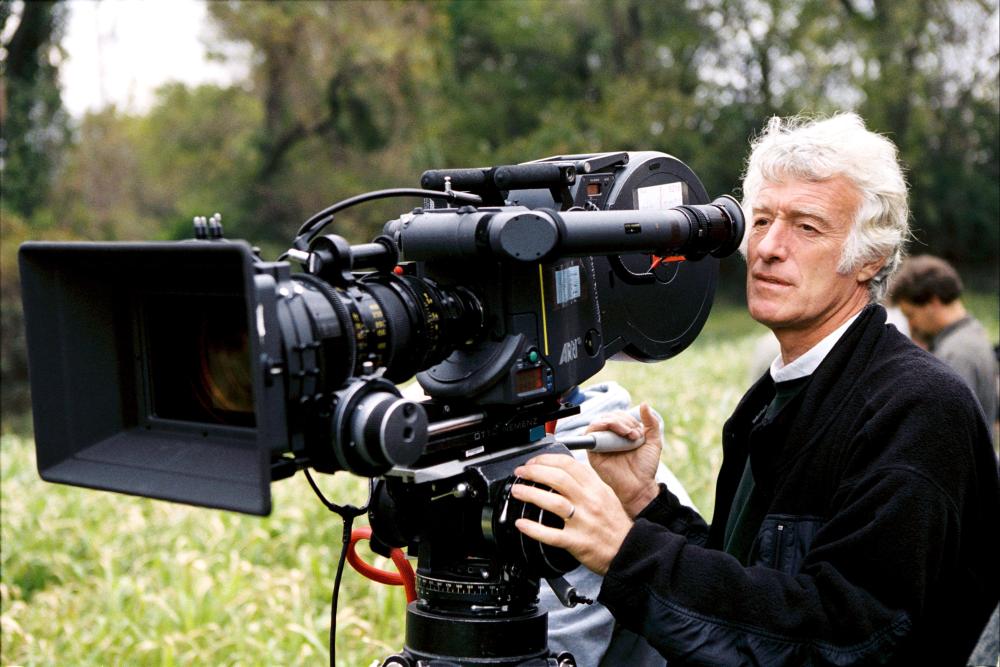
In the world of contemporary cinema, few names carry as much weight or evoke as much reverence as Sir Roger Deakins. Often hailed as the greatest living cinematographer, Deakins has spent over five decades refining the art of the moving image. His work is not merely about “beautiful” shots; it is a masterclass in visual storytelling, where light, shadow, and composition serve as the silent narrators of a film’s emotional heart.
The Early Frames: From Stillness to Motion
Born in 1949 in the seaside town of Torquay, Devon, Roger Deakins did not start his journey with a cinema camera. His first love was still photography. After studying graphic design at the Bath Academy of Art, he was initially rejected by the National Film School because his portfolio was deemed “not filmic enough.” Undeterred, he spent a year documenting the disappearing rural life of North Devon, capturing the rugged honesty of the English countryside.
This period was foundational. It instilled in him a documentary instinct—a commitment to “visual authenticity” that would become his hallmark. When he was finally admitted to film school, he brought with him a unique perspective: the ability to wait for the light and the patience to let a story reveal itself within the frame. His early career in the 1970s and 80s was defined by documentaries and music videos, providing a gritty, versatile training ground before he transitioned into the world of feature films.
The Philosophy of Subservient Beauty
One of the most striking things about Deakins is his humility toward his craft. He famously argues that cinematography should be “submissive to the script.” For Deakins, if an audience walks out of a theatre thinking only about how “pretty” a shot looked, he feels he has failed. The goal is to create an immersive experience where the visuals are so tightly woven into the narrative that they become invisible.
This philosophy of “naturalism” doesn’t mean his work is plain. Rather, it is meticulously crafted to look effortless. Whether it is the soft, diffused light of a prison cell in The Shawshank Redemption or the oppressive, monochromatic heat of No Country for Old Men, Deakins uses light to manipulate the audience’s subconscious. He is a “sculptor of light,” often preferring single-source lighting and practical lamps to create a sense of grounded reality.
Iconic Collaborations: The Coens, Mendes, and Villeneuve
A cinematographer’s legacy is often defined by their partnerships, and Deakins has enjoyed some of the most fruitful collaborations in Hollywood history.
- The Coen Brothers: Beginning with Barton Fink (1991), Deakins became the visual architect for the Coens’ quirky, dark, and visually distinct worlds. From the stark, snowy landscapes of Fargo to the sepia-soaked Americana of O Brother, Where Art Thou? (the first film to use a digital intermediate for color grading), Deakins proved his incredible range.
- Sam Mendes: With Mendes, Deakins pushed the boundaries of technical possibility. In Skyfall, he redefined what a “Bond film” could look like, using neon-lit silhouettes and fire-drenched shadows. This partnership culminated in 1917, a film famously designed to look like a single, continuous shot—a Herculean feat of choreography and technical precision that earned him his second Academy Award.
- Denis Villeneuve: In Sicario and Blade Runner 2049, Deakins embraced a more brutalist, atmospheric style. The hazy, orange dust storms of a futuristic Las Vegas in Blade Runner 2049 provided some of the most iconic imagery of the 21st century, finally winning him his first Oscar after 13 previous nominations.
Master of the Digital Frontier
For a long time, Deakins was a staunch supporter of traditional film. However, unlike many of his contemporaries who resisted the digital revolution, Deakins eventually embraced it with open arms. When he transitioned to the Arri Alexa for In Time (2011) and later Skyfall, he didn’t just adapt; he mastered the medium.
He found that digital allowed him a level of control over the image that film couldn’t match, particularly in low-light situations. Despite the change in technology, his eye remained the same. He proved that the “soul” of a film doesn’t reside in the chemical makeup of the stock, but in the intentionality of the person behind the lens.
Beyond the Lens: The Team Deakins Legacy
Sir Roger Deakins is also unique for his openness and desire to give back to the filmmaking community. Along with his wife and long-time collaborator, James Ellis Deakins, he maintains an active web forum and hosts the Team Deakins podcast. Here, he breaks down the technical barriers of Hollywood, offering advice to aspiring filmmakers on everything from lighting setups to the importance of collaboration.
His knighthood in 2021 was a formal recognition of what the industry had known for decades: Roger Deakins is a national treasure and a global icon of the arts.
The Deakins Touch
What makes a “Deakins shot”? It is often a combination of wide-angle lenses that place characters firmly within their environment, a masterful use of silhouettes, and a penchant for “motivated lighting”—light that feels like it has a real source within the world of the film.
But more than any technical trick, the “Deakins touch” is a sense of soul. His images carry a weight of loneliness, a spark of hope, or a looming sense of dread, all captured with a clarity that feels more real than reality itself.
As cinema continues to evolve into an era of heavy CGI and virtual sets, Deakins remains a reminder of the power of the human eye. He is a craftsman who understands that while technology changes, the fundamental human need for a well-told story, told through the honest interplay of light and shadow, remains eternal. From the muddy trenches of WWI to the neon streets of a dystopian future, Roger Deakins has not just filmed movies; he has defined the way we see them.
Leave a Reply